Saturday, 9 November 2013

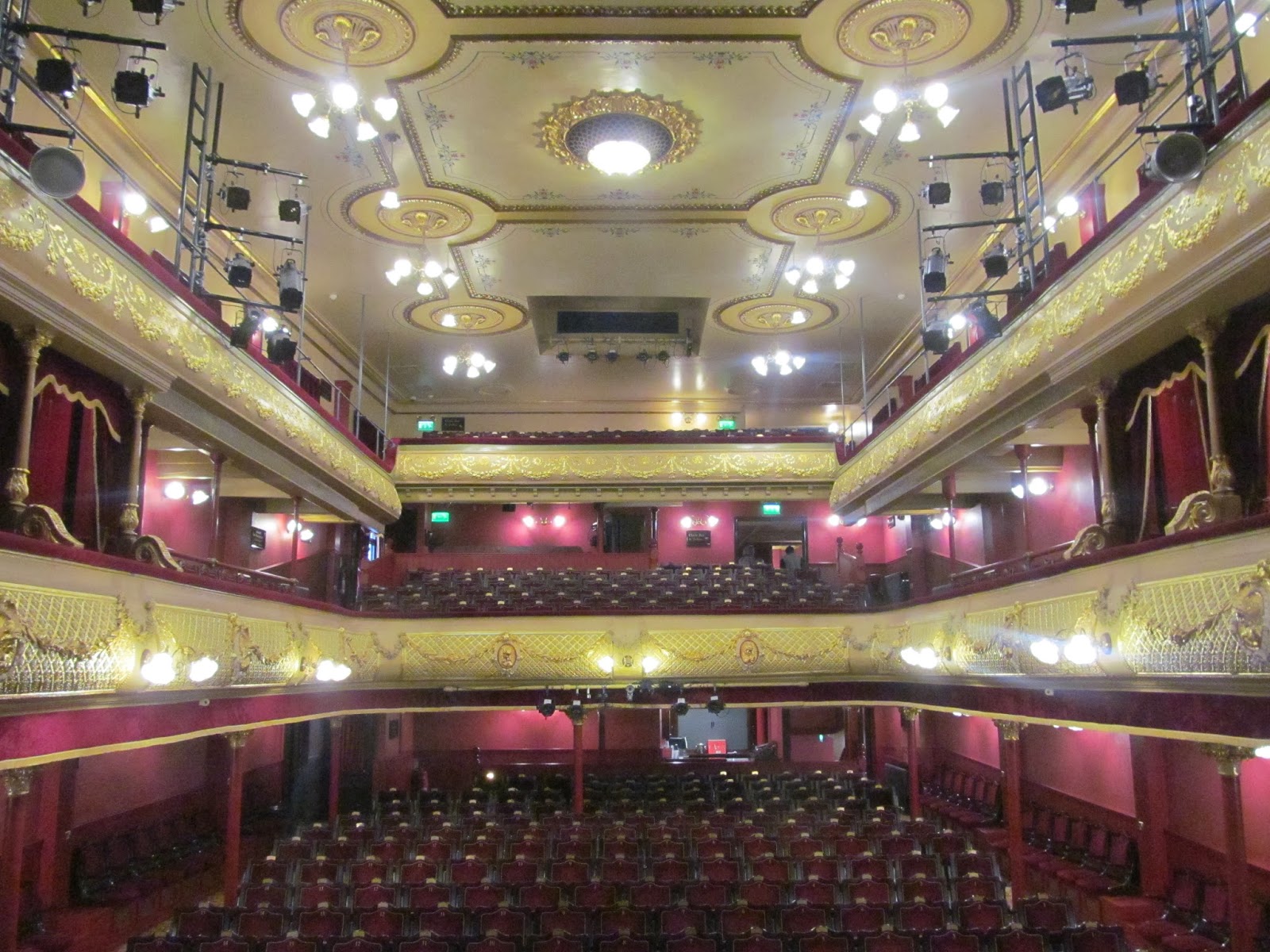
Exploring the City Varieties Music Hall, Leeds


I've booked myself one of their Public Heritage Tours which are hosted the venue's creative learning team.  We had a very interesting tour of this beautiful Grade II venue including a return visit to backstage and stage.  I remember my last visit backstage during the Heritage Open Days in 2012 when I paid a visit to the City Varieties Music Hall.  It was nice to view the the empty auditorium from the stage and admire the interior decor including the  gold plated decorations.  It was also nice to sit in the stalls, dress circle and upper circle whilst  listening to the City Varieties Music Hall's interesting and rich history, which goes back to its humble days of 19th Century where it began its Music Hall history.


I was interested to note the royal crest at the cornice above the stage's curtains.  Apparently, the City Varieties Music Hall, at the beginning of the 20th Century, was visited regularly by King Edward VII and the venue must have met his approval.  He would hire a box, very near to stage and albeit unseen, to see Lily Langtree perform on stage and sneak backstage to visit her at her dressing room.  He often visited the venue en route to his weekends away at Harewood House, stately home in North Leeds.


History of the Leeds City Varieties

It was built in 1865 and today is only one of a few surviving Victorian music halls built around that time.  It was originally called Thornton's  New Music Hall and Fashionable Lounge by Charles Thornton (Thornton arcade is named after him).  There was a Singing Room above the Swan Inn and was very popular with the locals especially of the working class and it was subsequently renamed City Palace of Varieties.  The Music Hall is famed for The Good Old Days, a BBC television programme, which ran for 30 years and still hosts live theatrical shows twice a year.  Many celebrities of the entertainment industry have performed at the City Varieties.

The City Varieties had a successful major refurbishment and restoration which Heritage Lottery funded and the venue closed between January 2009 and September 2011.  Today it seats 467 and some of the balcony section are now permanently cordoned off for the additional stage lighting.  The White Swan serves as a perfect pre and post theatre meeting points as both venues are linked.

City Varieties have kindly let me share some of their photos of the music hall prior to the 2009 refurbishment:

 City Varieties Auditorium prior to Pre Refurbishment (Credits: City Varieties and photos by Roy Hampson and Phill D)
I've seen some great productions there and hope to see more in the not too distant future.  Here's the link to the City Varieties and they can be liked on Facebook (City Varieties Music Hall) and can be followed on Twitter: @CityVarieties

Please check out my previous blog of a past visit to the City Varieties during 2012 Heritage Open Days.

Sunday, 3 November 2013

Opera North's Festival of Britten - Death In Venice

There's a moment when the audience realises the artist
 has found his muse and cannot leave, 
despite the city sinking into death and disease - Opera North, 2013


 Opera North's Death in Venice

The second opera I saw (as part of the Festival of Britten) was Britten's final one, Death in Venice which premiered at The Maltings, Snape, in 1973.  I never heard of Death in Venice until seeing Luchino Viconti's film.  I learnt from watching the movie that it's necessary see it not at face value.  Underneath the Venetian beauty there are thoughts which may contradict the city's mainstream perceptions and societal attitudes.  It's a test to how one in society really sees aesthetic beauty whether it's prescribed or described.

The opera is one of a very few I've seen that has reached the depths of my soul and appreciate the deep feelings of Gustav Von Aschenbach (Alan Oke) experienced which were raised and I know it directly and indirectly affects every one of us in society.  

The libretto is written by Myfawny Piper based on Thomas Mann's novel.  The incredible production is directed by a talented creative team originally led by Yoshi Oida.  The team includes Tom Schenk (Set designer), Richard Hudson (Costume designer), Paule Constable (Lighting designer) and is renowned for her work in the award winning National Theatre's The Curious Incident of the Dog in the Night Time) and the revival director, Rob Kearley.

I was in awe with its simple sets and perfect for telling such a complex story like Death in Venice.  There were a variety of themes explored in the opera's two acts such as travel, escapism, perception of arts and beauty, sexuality and Greek philosophy.

Britten used his musical genius to capture the unearthed beauty of Tadzio (Emily Mezieres) and Von Aschenbach's ongoing deep thoughts, feelings and philosophical views which assisted his anxieties and obsessions.  The 'voices' of Apollo and Dionysus (James Laing) represented the Greek philosopher(s)' definition of aesthetic beauty and art which guided Von Aschenbach thoughts of Tadzio.

Since the 1940s, Britten had the desire to do this opera based on Mann's novela because of the themes explored. Over 30 years later, with connections with W.H. Auden, he would finally write his final opera which was crucial to him and his partner, Peter Pears.  It's suggested that the themes declared to Britten's personal life which gave him the impetus to compose Death in Venice.  Mervyn Cooke discussed how deeply the composer felt about the story and the deep impact it had on him.  Cooke stated the story being 'hauntingly poetic' and 'the exploration of fundamental issues' (Cooke, 2013, p. 79).

There are definite close parallels between Mann's Von Aschenbach and Britten such as the ambiguous sexuality, innocence, the contrasts of artists' opinions between intellectual views/prescribed approaches and Romanticism/Sensual liberty (Rees, 2013, p. 86 and Cooke, 2013, p. 79).  Both travelled including Venice as a 'necessary evil' as both experienced a 'creative block'.  Britten sought creative inspiration whilst he was abroad (not just in Venice) which was right for the issues raised in Death in Venice (Cooke, 2013, p. 80).

Philip Reed concluded in his article what Death in Venice along with his operas 'offer a representative cross-section of his theatrical interests' (Reed, 2013, p. 71) and I dare say I agree! So glad I had the opportunity to have see two operas composed by the legendary composer.


Acknowledgement/Credit of Sources: Leeks, S. (Ed.), August 2013, Opera North Festival of Britten Programme (ps. 71, 79-80 & 86)

Opera North's Festival of Britten - A Midsummer Night's Dream


'There's a moment when the orchestra breathes the forest into life. 
Somewhere a powerful primeval force is woken from sleep' - Opera North 2013

 Quote from Opera North's A Midsummer Night's Dream

The festival celebrated the centenary of Britten's birth.  This year he would have celebrated his 100th birthday.  Opera North organised this festival and it's special to the company because of its founder, Lord George Harewood, was passionate about Benjamin Britten and supported the composer's professional and personal life.

To be honest I haven't heard much of Britten and his music.  Curiousity had got the better of me to take the opportunity to book a couple of operas including A Midsummer Night's Dream at the Leeds Grand Theatre.

The Opera

I usually choose Shakespeare's tragedies over comedies.  However I was interested to see how this comedy is done in an opera format.  The text was written by Britten and Peter Pears based on the Shakespeare play.  This production is directed by Martin Duncan and choreographed by Ben Wright and the opera is done in three acts.  Unlike the play the synopsis focuses exclusively on the characters' activities in the woods.  There are familiar characters such as Oberon (James Laing), Tytania (Jeni Benn), the young couples (Hermia-Kathryn Ridge; Andrew Glover-Lysander; Sky Ingram-Helena and Quirijn Delang-Demetrius) escaping from Athenian Society and workers (Quince-John Savournin and Bottom-Henry Waddington) rehearsing a play; and the magic casting Puck (Dave Abelson).

Britten's opera was beautifully conducted by Stuart Stratford.  I adored the use of percussion including the xylophone that was played throughout the performance.  Jonathan Keates discussed that Britten was fascinated by the characters in A Midsummer Night's Dream and that he cleverly composed unique forms and styles musically to reflect the diversity and unique identities of these Shakespearean groupings (Keates, 2013, p.60).  I could tell the music was influenced by his travels in Far East Asia.

The impressive staging designed by Johan Engels was complemented by Bruno Poet's lighting.  The creative team and crew have put on a successful opera as well as the talented cast.  It was evident how well the opera was received from our cheers and applauses on the evening!  

I appreciated A Midsummer Night's Dream a lot more than before.  What is important were the messages which Shakespeare and Britten were getting across to everyone.  I also understand why Britten and Pears wrote the libretto the way they did.  Combining my personal thoughts and reading the articles by artists/art professionals in the Opera North Festival Britten programme (co-ordinated by Stuart Leeks), I came to a comprehensive contextual understanding of Britten's opera.

I felt the main messages in the opera were focusing on gender, sexuality and society and its portrayals whether during Athenian Society, Elizabethan and Shakespearean era or today in the 21st Century.  Gavin Pumley discussed that Britten had mixed crucially 'the Arcadian ease of the Shakespeare ritual with the unconventional love and its acceptance in a modern society' (Pumley, 2013, p. 51).

The opera was first performed in 1960, a time when big social changes were soon about to take place.  With hindsight Britten must have been aware and this could have influenced him whilst he composed the opera.  Plumley continued with this thoughts and said it reflected 'some of the mind-bending narcotics and social change that were central to the decade's history' (Pumley, 2013, p. 52).  He considers that the British Midsummer, traditionally celebrated by pagans, is 'a feast of changing perceptions'.  Plumley concluded that the play is perfect for the disparity to be established between the groups and its intricate actions (Pumley. 2013, p. 52)

Another thing to note is that Britten composed this opera for a journey of self discovery through ambiguous humane and societal circumstances and his 'forest in the dream' (Pumley, 2013, p. 53) is used as a metaphor for his journey to happen in reality too.

Acknowledgement/Credit of Sources: Leeks, S. (Ed.), August 2013, Opera North Festival of Britten Programme (ps. 51-3 & 60)

Saturday, 12 October 2013

Sushine on Leith

I went to see Sunshine on Leith at my local cinema yesterday (11th October 2013).  Beforehand, I've had heard mixed reviews.  However I wanted to judge for myself.  Subconsciously, I had a feeling I would enjoy it very much especially it being set in Scotland and the wonderful songs by the legendary Scottish Band, The Proclaimers.

Check out their Facebook page!

The movie starred Paul Branningan, Freya Mavor, George Mackay, Antonia Thomas, Peter Mullan, Jane Horrocks, Jason Flemyng and Kevin Guthrie.  They did a great job with their roles in the movie.  The movie celebrates and explores life of a close family and the three couples that are part of it.  Like life, they experience the good and not so good in their relationship journeys.  It fitted nicely to the incredible songs and music from The Proclaimers.  I loved the optimistic stance from the characters involved.  It made me feel feel good about myself and the opportunities in my future journeys especially next year!

Dexter Fletcher did a great job directing the movie based on the talented Stephen Greenhorn's film script.  A similar vein to Mamma Mia and a movie I highly recommend.  Seeing the movie reminded me of the happy times I had in Leith and Edinburgh from a number of trips I've made to Scotland's capital.  Here, below, are some photos from the special memories made there.


Photos from Leith


Photos from Edinburgh

Friday, 11 October 2013

My Generation


I was very excited seeing this play, set in Leeds and written by Alice Nutter.  I was interested to see how life, especially in a political and social context, was lived by those who pursued an alternative lifestyle than to the one that is commonly associated.  Many misunderstood their beliefs and disapproved their lifestyles.


My Generation spans over 40 years of political and societal events from 1970s up to 2013.  The stories are told by one family and at specific times where a lot of events happened and developed/affected the cultural/social and political landscape.  Four members of the same family tell their stories chronologically.

The story of Cath (Kaye Wragg) highlighted 1977 amidst the Yorkshire Ripper Murders and the rise of Radical Feminism with which she challenged her partner's role within the squat.  It was nice to hear of the Neighbourhoods I know so well, such as Chapeltown, when Cath and Frey (Helen Bradbury) had a ride out.

Mick (Craig Conway) played a pivotal role in supporting the miners' strike during 1984/85 and supported the miners at the picket lines.  The comment Mick made reinforced his belief that many in the mining communities with pit closures would destroy the community and life round the pits despite eventually feeling apathetic about the strike.  This reiterates what Alice Nutter said about that the fight is for the ordinary human beings.

After the interval, we heard Ben's Story (Craig Gazey).  His passion for partying through his experiences of raves including the last free music event at Malvern Hill before large gatherings without a license became illegal.  I was interested hearing the references to techno and its subculture which I knew through its music in the 1990s and the party drugs that were available at the raves.

Finally we hear Emma's Story (Helen Bradbury).  Her story is a very familiar one today.  In 2013 there is still the ongoing economic crisis and cuts to public services affecting families.  She saw families queues at pawnbrokers, a common sight today, and I noticed the lack of community cohesion in comparison to when she was growing up in a communal home.  It seems to be Emma is disillusioned with the present as much as the past.  She's striving for a lifestyle for her and her family, despite the set backs, and is ambitious especially for her daughter and ensures she's well provided.

At the end it was nice everyone to be reunited.  The family and friends who were associated with them since the 1970s got together and had a sing along.  It was very heart rendering to hear them sing with optimism for the past, present and future despite issues.

What Alice Nutter achieved is ensuring the audience is listening to the stories firsthand by those who lived the lifestyles.  Before the play I took some time out to see a photo exhibition by Andrew Bannerman-Bayles and Andrew Medcalf.  The exhibition is curated by East Street Arts.  The photos told me of a story parallel to My Generation about those living an alternative lifestyle and fought to what they believed and not scared of being themselves!

I thoroughly enjoyed this play.  It was nice to hear the stories told by those who I haven't heard from mainstream society, media and so forth and obscured with their negative references about them.  It was important to have learn their aim is about 'ordinary people struggling to be human' (Nutter 2013) and being 'free' without restraint.  Their wish, which I think is very commendable, is to have helped those who have suffered marginalisation and misrepresentation because of not agreeing with the Status Quo.  With West Yorkshire Playhouse support, Nutter reckons, in an interview with Steve Bottoms, that James Brining, the artistic director, is looking for plays which are told by different communities.  I personally welcome this as this enables me to appreciate more the different communities in Leeds with their diverse cultures and interests whether politically and socially.  Also how this shaped the city which I'm very proud of over the past forty years.  I always believe there are at least two sides of the story, which one needs to be aware of about the development, culturally and politically by all.

A big thanks to talented cast especially the younger members which were played by the Blue Team (Hannah Kilcoyne, Thomas Gould, Hannah Kerr and Leo Mercer).  My Generation is blessed with an fantastic creative team including Harry Hamer, musical director/composer and who was in Chumbawamba with Alice Nutter, Max Webster (Director), Ben Stones (Designers), Charles Balfour (Light Designer) and Ian Trollope (Sound Designer).

My Generation is on at the West Yorkshire Playhouse until the 26th October 2013.

Wednesday, 9 October 2013

Sweeney Todd - The Demon Barber of Fleet Street


 It's my second time I've seen Sondheim's Sweeney Todd after seeing an Opera North production once in the past.  The joint West Yorkshire Playhouse/Royal Exchange Theatre production is currently on in Leeds and will transfer to Manchester after its run.  James Brining, Artistic Director for West Yorkshire Playhouse, is directing this production following a similar one which he directed at the Dundee Rep.

Sondheim wrote the music and lyrics and Sweeney Todd is based on Hugh Wheeler's book.  Angela Lansbury (known in Murder She Wrote TV series) and Len Cariou starred in the original production.  It became one of Sondheim's popular musicals and subsequent revisions were produced including a Chichester Festival Theatre production in 2011/12 starring Imelda Stauton and Michael Ball.  Many will also know Tim Burton's film adaption starring Johnny Depp and Helena Bonham Carter in 2007.

Brining wanted Sweeney Todd to attract the audience - not just enjoying a classical musical but also to think about the messages raised and how these relate to us in the world today especially politically.  In the programme, Brining discussed this further with Stuart Leeks and how society can make or break people followed by consequences (Brining and Leeks 2013).

It's interesting to see how the staging was set in a modern era which is cleverly designed by Colin Richmond and Chris Davey and set to the original musical score used and directed by George Dyer.  I think it's important for the audience to connect to the social and political context of the musical both in the Victorian times and also today.

I remember, when growing up in the 1980s, the social and political disillusion, the gap between the rich and the poor and the hierarchy of powerful people.  It's only decades later that you realise the corruption and consequences from these issues mentioned especially in the media and also from reflecting on personal experiences.  Sweeney Todd tells the story about being a victim of injustice and the manipulation of power from society and this lead to Sweeney to becoming revengeful to those who were in position of trust to society.  Brining summarised about modernising the production is 'that it has a connection with us at a more immediate societal level' (Brining 2013).

We had an exceptional cast with David Birrell as Sweeney Todd and Gillian Beven as Mrs Lovett.  It was great seeing Don Gallagher (Judge Turpin) and Niamh Perry (Johanna) whom I've seen in Priscilla (2011) and Love Never Dies (2010) respectively.

I thoroughly enjoyed Sweeney Todd and seeing it for the second time has made me appreciate the musical even more.  A big thanks for a great production to both the cast and creative team.  Sweeney Todd is currently running at the West Yorkshire Playhouse until 26th October 2013 and will transfer to Manchester Royal Exchange Theatre afterwards.  This production is highly recommended!


Sunday, 6 October 2013

Light Night Leeds - 4th October 2013


I participated in my first ever Light Night! It's an arts event held annually in Leeds and where many buildings open their doors in the evening showcasing a variety of art projects from performance to light installations.


Views from Leeds Town Hall's Clock Tower

Just before Light Night began I climbed up Leeds Town Hall's Clock Tower. I had to book at ticket in advance as it's very popular to do!  A bit about the Leeds Town Hall:  The Victorian building was designed by Cuthbert Broderick and built in 1858 (further works were down for another 9 years!).  The Town Hall originally had four court rooms (used until 1992) and prison cells.  Today, it's a working building for Leeds City Council and used for civic events and celebrations.  It was worth the steep climb of 200+ steps for the great views across Leeds.  Afterwards we descended and soon Light Night officially began!

 Sea Interludes Installation, Howard Assembly Room


Another highlight was checking out the Sea Interludes Installation at Howard Assembly Room.  What an incredible installation project! There is this fortilla of boats which you "sail" in while you listened to Britten's Four Seas Interludes from his opera, Peter Grimes.  I loved how the music projected with the image visuals on the sails.  I also loved how the soft but effective lighting portraying the sea and the atmosphere. I spent some considerable time there capturing the mood of the installation and being part of the Northern Seas.  I plan to make a return visit to the installation later on in the month.  


My favourite project was the Momentus Illuminos at the Leeds Civic Hall on Millennium Square.  The building was transformed to a large Potts Clock Face with cogs, levers, chimes.  Whenever the clock chimed every quarter hour, video footage was shown of mechanic people celebrating and getting on with their daily lives in Leeds via movements.  The projection was accompanied by a soundtrack of the clock moving, whirring and chiming.  When the clock struck, music accompanied the mechanic people's activities.  Seeing this amazing illumination made me realise how proud I am of Leeds!


Momentus Illuminos Project, Leeds Civic Hall 

I've checked out some other arts projects.  As much they were innovative and interesting they weren't to my personal taste! Light Night is a great opportunity to celebrate Leeds culture and heritage.  It's an opportunity for Leeds residents and visitors to the city to enjoy what the city has to offer!